This very site —
built in the open.
The first project in this list is the one you're standing in. We're our own most demanding client, so we built the studio site the way we build for everyone else — small, honest, and made to last — and left the workings on show.
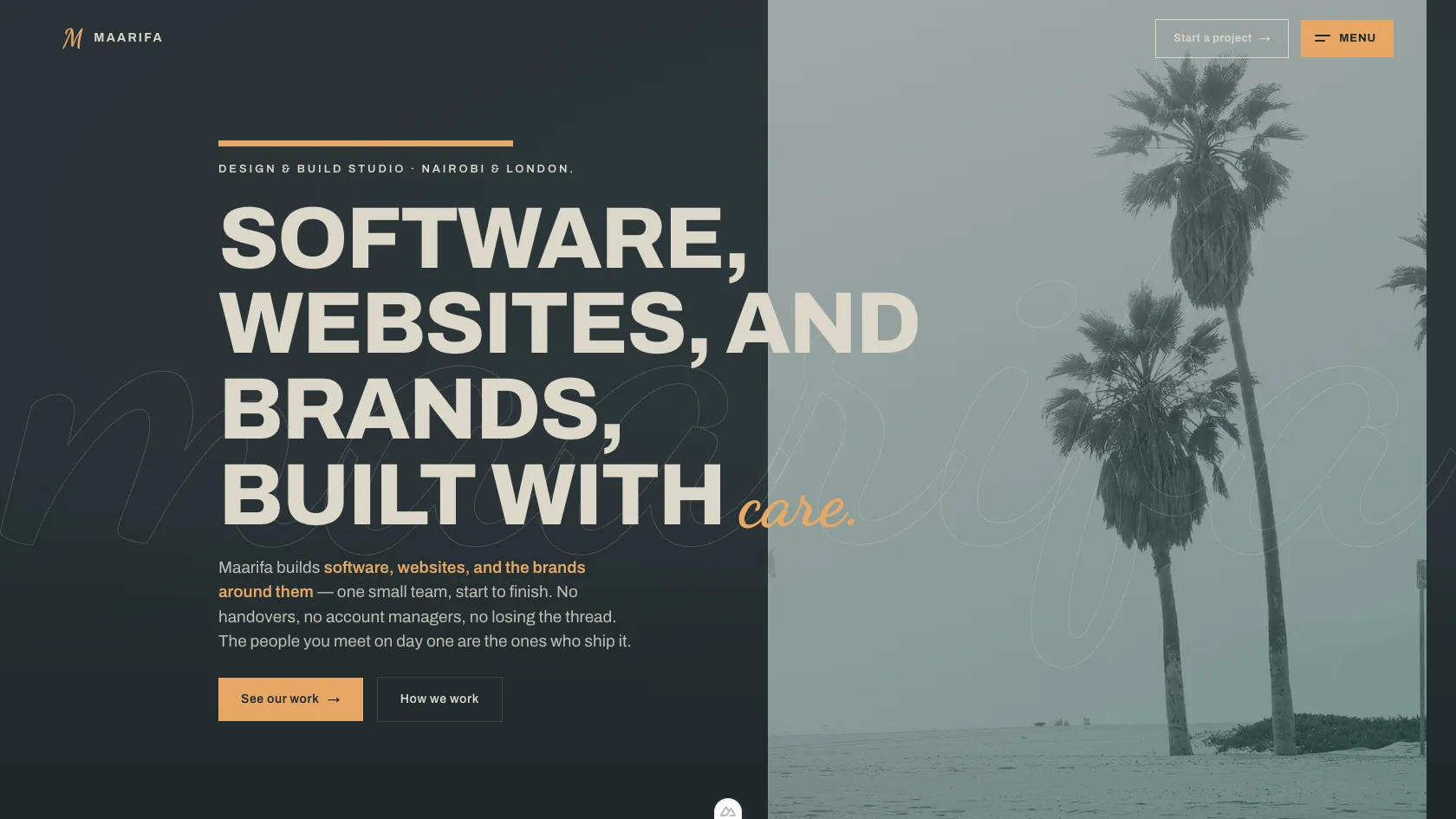
The hardest brief we've had is our own.
A studio that builds websites has an awkward first problem: its own website. It's the one project where you're the client, the deadline, and the person who lives with every compromise — and where every visitor is quietly deciding whether you can actually do the thing you say you do.
Most studio sites talk about craft. We wanted one where the craft is the thing you're standing in — where "how we work" isn't a page you read, it's the experience of being here. If the site couldn't prove it, we wouldn't claim it.
So we set three rules before drawing anything: it had to read like a person wrote it, arrive faster than you'd expect, and keep nothing about you that we couldn't account for out loud.
Warm paper, three good typefaces, and the small things most people skip.
Warm, not white. The whole thing sits on a cream paper instead of stark white, with a deep forest ink and a single amber for emphasis — no gradients, no second accent, no colour smuggled in to rescue a weak layout. When the palette is that restrained, the writing and the spacing have to carry the page, so that's where the hours went.
Three typefaces, three clear jobs. Instrument Serif makes the statements — one italic-amber word each, never more — Newsreader carries the long reading, and Instrument Sans — the serif's own companion face — does the working type: the navigation, the labels, the buttons and the fields. It's an editorial look on purpose, closer to a well-set magazine than a corporate template.
The type is also a small lesson in the kind of detail we mean. The faces are self-hosted — served from here, so nothing phones home to a font company as you read — and because we reference them through CSS variables, the build tool quietly declined to bundle them at first and everything fell back to a system serif. Catching that, and fixing it so the real faces load with no layout shift, is exactly the half-hour that separates a site that's fine from one that's right.
Motion, used sparingly. Rather than colour doing the shouting, things move — text fades up as the page settles, sections rise in as you reach them, one marquee drifts under the hero. It's quiet, it happens once, and it switches off completely for anyone whose device asks for less motion.
A quiet bit of character sits in the free tools, too — Askari, the reader that fetches a page and hands back plain English. We tried it as a mascot on the page itself and pulled it back: the writing and the white space should be what you notice, not a cartoon in the corner.
It arrives fast, and arrives whole. Every page is rendered to plain HTML ahead of time and served from Cloudflare's edge, so it paints in about a tenth of a second before a line of JavaScript has run. There are no analytics, no ad pixels, no third-party trackers on any page — and the cookie note names every last thing we store, in your own browser, with a "store nothing" button that genuinely stores nothing.
Then, instead of buying ads, we built three small tools and gave them away — each wired to something real. The website check-up actually fetches your page and a few it links to and grades around twenty things in plain English — and can keep a monthly watch on a site if you ask; the name check reads live domain registries and the socials it's allowed into; and the robot’s-eye view shows what a search engine or an AI actually reads on a page. No sign-up, no email to use them — they're the clearest sample of how we think, because you can use them right now.
Reachable, and accessible, by default. Two live clocks show whether we're at our desks in Nairobi and London; a keyboard skip-link, proper landmarks, visible focus rings and labelled fields are standard, not an afterthought. The whole site is one small team's work from first sketch to last deploy — which is, in the end, the entire point.
If the site can't be honest, nothing we build on it can be.
Want to be next?
Tell us what you're building. We reply within a day, usually the same one.
Start a project →We put our own work on the same scale we’d hand you — this page arrived in about a tenth of a second, nothing on board it didn’t need. See what yours is carrying — the check-up’s free →